Saturday, May 7, 2011

Star-Struck: Calamity Jane

When I Get Home, I'm Fixin' to Stay!


I originally planned on doing 5 films for this Star-Struck, including Annie Get Your Gun in the last position, but in my review it became more and more apparent I couldn't really list it as a greatest.  Now there are certainly reasons to see it, being Keel's first lead role, having the wonderful sparring duet I Can Do Without You and I do give props to Betty Hutton for doing her best with a tumultuous casting.  However, the metamessages of "ain't those injuns just so quaint and dumb" and " you can't expect your man to love you if you put your personal strengths ahead of his pride" plus the general backstage nastiness behind the production really sours my viewing.  This story was done almost identically 3 years later in Calamity Jane, and better, so that is the only one I shall review.  'Nuff said.


Calamity Jane was written for Doris Day by the brothers Warner to appease their box-office sweetheart after she was passed over for the title role in AGYG.  The movie is unabashedly similar to Annie from the basis on a historical female sharpshooter down to the appearance of Howard Keel.  However, Calamity takes the nasty-minded edge off Annie's themes and gives them a much-appreciated softening.  Here the "Injun" mentality is not as embarrassingly in-your-face, if only because their caricatures are largely brushed to the side as a casual fact of life outside the bigger storyline.  The main focus is the love quadrangle with Day as Calamity, hopelessly smitten with Lt. Danny, a man everyone cannot help but notice has no interest whatsoever in Calamity.  Both Danny and Calamity's old chum, Bill Hickok, fall for showgirl Katie Brown (Allyn McLerie) who comes to town looking for a chance at stardom.  While there are still some disparaging references to "female thinking," Calamity vastly improves on Annie because that the obvious reason Calamity and Danny can't be together is not because she is too manly to be loved, but that Danny is a superficial douche.  Sure, Howard Keel's character appreciates Calamity's makeovers, but he never asks her to give up any essential part of herself, and seems to fit best with her because of it.


I like Doris Day.  I like her voice, her on-screen cheeriness and the game way she went for her character.  Calamity isn't the glamorous role in the film you would expect a 50's starlet to be campaigning for, but it is the most interesting.  Bill Hickok is the most agreeable of Keel's film characters.  Often his charisma and charm must overcome his douchiness, the man you love in spite of yourself.  But here more than anywhere else he is the guy you really want the girl to go for, the guy that we ask why there can't be more of, and it suits him.  The supporting roles do well enough, I especially loved Dick Wesson doing his Francis Fryer routine.  Because a movie can always use a good drag number to liven things up.


The numbers are all quite good- Secret Love being the big Oscar-winning hit and a huge success for Doris Day.  The Deadwood Stage and The Windy City are catchy, although I will concede the one place Annie outperforms Calamity is in the feuding song: I Can do Without You, a bald copy of Anything You Can Do, cannot hold a patch on it's predecessor.  


Calamity Jane can borderline on silly at times with its 50's era sensibilities, but that doesn't stop it from being an absolutely enjoyable film.  For Howard Keel fans, I'd say this is his most likable character.  And it's a Doris Day western.  That kind of thing shore don't come 'round ev'ry day. : )


My Rating:
8/10 ********

Friday, February 25, 2011

The Disney Derring-Do: Bambi

Childhood Trauma: It's the Stuff of Life


Now I must admit I wasn't being entirely truthful in the timeline for Dumbo.  I'm trying to keep things as simple as I can- history can get really muddy if I let it and one of my objectives in these reviews is to try not to drag on with too many major references to films that were released after the one I'm reviewing.  Hindsight can be an asset, but it also kills a lot of the dramatic heft, and I loooove drama.  So here we go:  When Walt was still in his ambitious planning phase, sometime in the 30's, he acquired the rights to the story of a young roe buck.  The story had been slated for live action when author Felix Salten declared it too difficult a few years before.  Walt was eager to develop it and scheduled a release after Fantasia with a much less gristly and depressing story and what I consider important change from roe to whitetail to better distinguish the protagonist.  By 1940, the story was pretty much finalized, but two factors: the failure of Fantasia & Pinocchio and the already swollen budget of Bambi, a similar film, brought the project to a halt.  If Disney was going to survive, it could not release Bambi next- it would completely drain the funds and current box office trends indicated there would be very little return, effectively dooming the studio.  That's were Dumbo was actually shuttled in and out of production: to bring in quick revenue so Bambi could be financed.  I have got to hand it to Walt- yes, he could give the public exactly what they wanted, but ultimately he was going to make the movies that mattered to him.  Maybe not the best way to stay in business forever, but I think that is what makes the movies of the Golden Age so different in almost every way from the ones that will follow- at that time the man in charge was not obsessing over the bottom line, he truly wanted to make his medium something wonderful.  And maybe get some money out it too.  This is, after all, an American success story.

Armed with the revenue from Dumbo, we are back to the oil backgrounds that would become the standard for animation.  As in the animation, they are much more representational of the natural world than probably any other film, feeling more like plein-aire paintings than stylized illustrations.That is nothing, though, on the task the animators faced.  Looking at Snow White alone, I would have called them crazy, but somehow the animators pushed through to create the most realistic traditional animation I have ever seen.  Gone are the potato-sack deer, and in place are these majestic creatures that were unimaginably difficult to create.   Now there are still softer, more cutesy characters like Thumper and Flower, designed and developed to help offset the emotional weight of the story.  And they pretty much keep to the range of cute but not overly cloying.  It all depends on your sensitivity.   Wacky sidekicks aren't my thing, but I can handle these.  They are certainly needed considering the amount of utter terror and despair packed in.  If this version is "Disneyfied," I am pretty sure I never need to read the original book for my personal well-being.  Of all the movies in the Disney canon, there are only 3 I would suggest you don't show to younger kids.  Bambi is one of them.  Maybe we do baby kids too much, I'm not here to espouse my ideas on parenting, but I distinctly remember the sheer panic that lurked around every corner- the theme of man haunting me like the footsteps of DOOOOOM, and the most psychologically scarring part of all where the quails are whispering "don't fly, don't fly" until one goes absolutely nuts and I am screaming at the telly "DON"T FLY, YOU IDIOT!"  It may have happened offscreen, but I knew in my youth that bird got shot, and shot dead.  Though there are plenty of beautiful and sweet moments, the movie is constantly tinged with fear, and soon it feels like joy is simply a trick to let your guard down, proven by the heartbreaking realization that Bambi's mommy has died, and yes, yours will too one day.

Ack and somewhere in here, I need to talk about the music!  Calling Bambi a musical is somewhat misleading, there aren't but 3ish songs (unless you count the bird songs) and all are sung offscreen by a magic Disney Chorus.  Little April Shower is far and away the best with the rounds imitating the pattering of a rainstorm.  I do quite like Love is a Song, in fact I wish it could have switched places with I Bring You a Song because it it infinitely better.

Bambi is a beautifully done, technically ambitious film.  Though dotted with memorable vignettes that enchant with simple pleasures, it still has a strong undercurrent of darkness- too strong for my tastes.  It's a demanding film, especially for younger people, and with all that, it's not hard to imagine Bambi underperforming at the box office.  I've heard tales of mothers dragging screaming kiddos out of the theater- and I do understand them being bewildered at the studio that just put out films as far from each other as Dumbo and Bambi back-to-back.  It didn't help that the incredible newness and difficulty of this style slashed the production of cells from 10 feet of film to half a foot per day and ballooned the budget.  Not to say that it's all doom and gloom: this was a huuuuge boon to the animator's library, a place were you could go back and get references, either of the live footage collected or the animation that went into it.  Bambi ground out a lot of the hard work for realistic animal animation: for pity sakes, one shot of Bambi's mother was still being reused in Beauty and the Beast, some 50 years later.

So here we are, at the end of the Golden Age.  It seems like this is the best place to stop and reflect on some things that were ending and some things yet to come.  As I said earlier, Walt was driven to make what he considered the best his medium could offer.   Each film from this period has something that really distinguishes it: Snow White in the sheer amount of firsts and for proving animated features can be done and done well, Pinocchio in the lushness of its backgrounds and leaps in animation, Fantasia in the overall artistry and special effects innovation, Dumbo in the expressive character development, and for Bambi it's the culmination of technical proficiency.  That gave us 5 wonderful movies, but it also created a crapload of trouble.  The studio roller-coastered from success to bankruptcy, always teetering on the edge of oblivion.  The increasing demands on innovation coupled with tightening budgets caused disillusionment among the artists, who went on strike, effectively ending the genial extended family atmosphere at the studios and, I believe, destroying Walt's hands-on interest in animation.  When Bambi finished, Walt packed up with his closest animators to head south of the border for one final rally.  No film afterwards would see his hand so closely stamped on it.  A happier note, one coinciding with Walt's distancing influence, was the transition to animators supervising individual characters rather than sequences.  This allowed animators to develop more distinct styles, to the point where you can attribute types of characters to their animators by design and movement.  This is where the famous nine old men began to shine.  It happened some in Dumbo, more in Bambi, and would take root in the 50s.  I'll do my best from now on to add individual animation credits where I can, because I believe these are the real actors, moreso than the voice work in most occasions.  It's sad to say goodbye to a time as good as this, especially when I know the next few years are going to get pretty rough- next stop: Package Films.


Quote of the Film:
Don't fly. Whatever you do- Don't Fly!

My Rating:
7/10*******

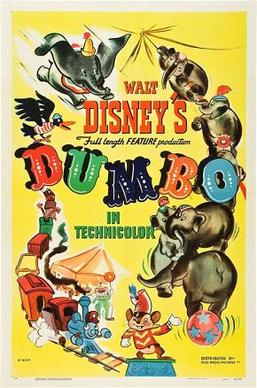
The Disney Derring-Do: Dumbo

The Little Film That Could


Dumbo is what I consider a "signifigant" film in any number of ways.  Which seems rather silly to say- if all the Disney films weren't significant in some way, I don't suppose I'd be reviewing them, but on we press!  Here Disney sat, 1 for 3, in very real danger of bankruptcy and with really only 1 shot left to bail his studio out of ever-present financial dangers.  The last two films he produced set the standard of artistic innovation yet remained unrelatable to contemporary audiences.  So Walt put on the breaks and laid out two conditions for the next film:  keep it simple and keep it cheap.  Perhaps not the stipulations one would expect for a beloved masterpiece, but hey, this is Golden Age Disney and every pore still oozes with magic (plus I cheated and know it's gonna end well).  So for starters, all backgrounds went back to watercolors for the last time in over 50 years.  Oh how I wish there was never that movie that kept it from being forever, but we'll get there eventually, Elvis lovers.  Yeah it was cheaper, but also so vibrant, so fresh and colorful and storybookish I can't imagine any other medium possibly coming close. The design was also drastically simplified- gone was the rigid, gorgeous arty animation, in came looseness and softness.  Now any of these cutbacks could spell doom: I never advocate cheapness for cheapness sake.  Ohhh, just you wait until we hit the dreaded Xerox era if you don't believe me.  But what the artists took from these constraints and molded with their immeasurable talents cannot be praised highly enough.  They replaced icy high animation with warm, visceral storytelling and relatable characters.  The time they saved in details they invested in character animation: Dumbo is utterly expressive without any voice: we understand his plight completely through nothing but pantomime.  Gosh, I am getting carried away with myself.  So anyways, the film got made- and here's my favourite just completely Disney part of the whole tale.  Dumbo's other cost-cutting factor was the emaciated running time, I'm talking 64 minutes from start to end.  Well  RKO wasn't too pleased so they gave Walt an ultimatum: either cut it to a short, add more runtime or release it as a B movie.  Well Walt being exactly the genius that he was, said none of the above, this is feature film, A-list material and that is how it will be released.  Can you imagine that?  Of course you can!  Haven't you learned anything from your wholesome Disney upbringing?  Psh.

Ok ok, so can I get to the actual film now?  The pacing is tight, the scant runtime absolutely flies by, but is always enrapturing.  The story is just so sweet, and incidentally, this was the first film for Disney set in contemporary times, though I will admit not the one to take the most advantage of the setting.  Here, it still seems to be something of folk tales, having an almost mythic quality.  The characters are all well done, though oddly there were no voice acting credits.  But that's what IMDb is for.  Sterling Holloway makes his first Disney appearance here as the stork, as does Verna Felton.  Perhaps the most surprising of all is Cliff Edwards as, ahem, Jim Crow, completely unrecognizable from his role as Jiminy Cricket.  And yes, I suppose the crows should be addressed.  Racism was not as absent from Disney as the notorious self-sanitizing histories would have you believe (just check out the Fantasia review), and yeah the crows are a pretty blatant stereotype.  There isn't much way around it, however, I will stand in defense that though regrettable, it was not a mean-spirited, or even particularly negative portrayal.  It's quite true that the crows are, Timothy excepting, the only ones to accept Dumbo and find worth in him.  Who would you rather have as friends, the crows or the elephants?  Plus they have the best (well, maybe second best if you like crying) song in the movie.

And this movie has a heap of great songs.  Of course there is Baby Mine, the emotional centerpiece, the one where you are obliged to boo-hoo simply to prove you have a heart.  And it is a cruel, beautiful segment.  When I See an Elephant Fly is really, really good too.  I cannot believe the raucous song was sung by the same man who so sweetly crooned When You Wish Upon a Star.  The others are perfectly good too.... and then there's Pink Elephants on Parade.  Orchestrated as an elaborate drunk dream, but played out like the baby was tripping on acid (as if drunk baby elephants weren't bad enough), this is the stuff of nightmares.  Disney has had its share of absolutely terrifying sequences, and I'm pretty sure every movie I come to will get a new label of most psychologically damaging, but seriously, THIS is some wacked-out mess.  I don't know how, and I especially don't want to know why, but Norm Ferguson, supervisor for that sequence, rove the land somewhere between genius and utter lunacy.

All in All, Dumbo is a warm, cute cute cute, and yet utterly sincere movie.  Frankly, you can be as corny as you wish, utterly drive me insane with syrup if must, and I will eat it all up if you can convince me you are sincere (Therein lies my beef with child actors in general- a whole lot of cutesy without a drop of sincerity.  Give me a sincere pumpkin patch, Charlier Brown!).  Those who follow in its footsteps will utilize the strength of homey storytelling and gestural characterization in varying degrees of sincerity, for it is a formula that works- when done well.  Perhaps Dumbo has not the most agressive of storylines in the Disney vault and paved the way for bad habits in films that handled constrained budgets without the grace of this one, but I cannot judge it too harshly.  In a time when the struggling studio was ready to fly or fail, this little wonder glided straight to the bank.

If only I could leave it there, a happy tale of a company that regained its footing and continued to make wonderfully brilliant movies in a magic kingdom until eternity.  Unfortunately, within Dumbo's production was one last pivotal moment, one that would bring the family to an end.  In May of 1941, the majority of the studio's animators went on strike.  Justified they might have been in their claims, but it cut Walt to the quick, and he is, after all, the hero in this tale.  Not to say he was perfect, but if I must choose protagonists, there is none more worthy of my overwhelmingly undue affections.  And eventually the issue was resolved and the animators came back, but it was never the same.  The family atmosphere had been destroyed: it was no longer Uncle Walt and his boys, it was Mr. Disney, the boss, and his staff.  Gosh, this is sad stuff, but there is hope!  Bambi, the last of the Golden Age films, was actually already in production before Dumbo was shuttled in and out, and though the strike certainly affected it, the ultimate results would not be felt for one last film.

Quote of the Film:
-Did you ever see an elephant fly? 

-Well, I've seen a horse fly. 
-Ah, I've seen a dragon fly. 
-Hee-hee. I've seen a house fly.

My Rating:
8/10********

Thursday, February 24, 2011

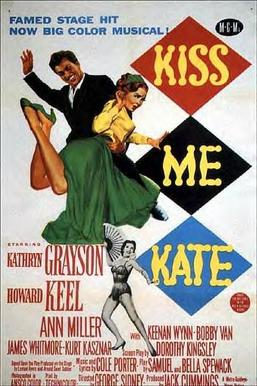
Star-Struck: Kiss Me Kate

It's Time to Brush Up Your Shakespeare


We kick off our Keel countdown with Kiss Me Kate, a film version of the Broadway show, itself a musical adaption of Shakespeare's Taming of the Shrew.  And let it be known far and wide, my love for all things Shakespeare- within reason.  I'm thinking my next list will be on Shakespearean adaptions.  And despite the moral bone a contemporary audience can pick with the play, it is undeniably clever in the sparring, often bitter spewings of a certain not-so-kissable Kate.  The tale is of two actors whose lives for the evening merge and somewhat mirror the main thrust of the play they are performing.  Fred (Keel) and Lilli (Kathryn Grayson) have ended their defunct marriage and will be giving one last performance together before she moves on to the greener pastures of a millionaire rancher.  As the show progresses, they reveal they are not as over one another as it may seem, though a series of mishaps involving costar Lois (Ann Miller) and her indebted gambling boyfriend (Tommy Rall) constantly get in the way.  All in all, it's a reasonably fun story, leaning a bit heavily on the "you must learn to obey your lord and master" side of things, but that is not to say that the Lilli/Kate character does not hold her own in a refreshing, for the 50's anywho, way.

Now, I must shamefully admit that I believed the 3D craze was a somewhat contemporary (sometime in the 90s-00s) thing.  I had absolutely no idea it went back in waves all the way to the 50s.  It puzzled me for the entire movie why actors were constantly throwing junk at the camera.  It was kind of surreal, like breaking the 4th wall in a way.  Now, I will never see this film in 3D, so I have no idea how successful it would have been, but it irks me to have that curtain of suspended reality somewhat raised.  But it is interesting, what with all the Avatar and 3D this and that, to know that they aren't such novel ideas after all.  Technicolor is hands-down the most beautiful way to shoot film in the history of cinema.  There is nothing more gorgeous, more lush than a film done well in technicolor.  Kiss Me Kate certainly takes advantage of the tool by having an outrageously saturated palette, in fact it often hurts during the stage sequences.  The overwhelming abundance of vivid colors, especially red, was on the garish side.  Kathryn Grayson looked beautiful as a blonde, perhaps even better than her natural brunette, but she was absolutely a fright in the hideous reddish wig they gave her Kate character.  I have never seen an actress with hair color less suited to her complexion or costumes.

Although I know it's a Broadway musical, I cannot help but be wearied by the sheer number of songs in the film.  The story could have been vastly lightened by the removal of some, where it would feel less like introduce a character- and sing about it!  Introduce a plot point- and sing about it!  Change scene- and sing about it!  I know I sound like the Emperor form Amadeus saying - cut a few, any few will do, but I am a big supporter of wanting songs to advance plot, not rehash and stall it.  Too Darn Hot, Why Can't You Behave, Brush Up Your Shakespeare and From This Moment On are the best of the 17 or 18 songs, though two I single out mostly for their dance routines.  From This Moment On is the best showcase of talent, a wonderful nod to the efforts of the dancers who don't always make it to the leading roles.

Speaking of, Ann Miller is saucy as ever and a wonderful dancer, one of the best tap dancers in Hollywood period as evidenced in Too Darn Hot.  Tommy Rall was just so talented- we'll be seeing him again shortly in Seven Brides for Seven Brothers.  Kathryn Grayson, she was alright.  I enjoyed the feistiness of her character, though I believe Jane Powell capitalized on the type better.  Though her voice is lovely, it can be so operatic and trilly I have difficulty following everything she sings, plus her style just doesn't mesh with the Broadway score or the styles of the other singers, except Keel, who could make a horse sound spectacular.  And then there's Howard Keel.  His character on script is a total douchebag: of all the characters on this list, this is the least likeable and the one with the shallowest arc.  But somehow when it's Howard Keel up there being all smarmy and whatnot, it's ok.  His charm and swagger are so powerful, all other senses are dulled while I quietly drool, knowing deep inside nothing he does could make it possible to despise him.  And I can't.  I simply cannot hate him.  Especially in guyliner.  Curses!

So over all, Kiss Me Kate is worth viewing, and viewing again.  Come on, it's Howard Keel doing Shakespeare while singing in a dead-sexy voice.  How can you not love it?

My Rating:

7/10*******

Thursday, November 25, 2010

The Disney Derring-Do: Fantasia

Animation at Its Best


If you thought that Walt was pushing the envelope with the previous 2 films, you ain't seen nothing yet. Starting as a spectacular short to boost the flagging appeal of Mickey Mouse, the project soon became too expensive to justify as anything but a feature, so the theme was expanded upon with additional forays into the world of sight and sounds it its purest forms. Fantasia was perhaps Walt's most perfect realization of animation as an art form, not only in expressing as-yet unmatched beauty on film, but marrying it with another, more accepted and established form of art- classical music. In a way, this was simply an extension of the previously popular musical shorts and a precursor to the package films of the later 40s, but altogether, Fantasia is way beyond that level. The staggering quality and effort put into making this an altogether unique experience- culminating in the doomed Fantasound experiment is so impressive it makes me weep to find it so underappreciated. For yes, in 1940, Fantasia was released to lukewarm audiences and financial disaster- sending the studio reeling to the edge of bankruptcy and officially obliterating any gains from the only big success to date. At the time, Disney was just another one-hit wonder.

Of course the only thing I have to wonder about is why people could be so indifferent to this film. Classical music has an air of snobbery and pretension to it- more due to the people who listen to it than the music itself. There are few styles that can translate more universally than classical- whether it be relaxing, invigorating or frightening. Even in contemporary music, you can find references and inspirations drawn from classical compositions. But, on to the movie! Fantasia is one of my earliest memories- and I believe it is because Walt hit upon a basic truth- you don't even need to have a grasp of the English language- or any language whatsoever to be moved by this film.

We open as though this is a real concert feature- just a title card and curtain before revealing the orchestra warming up. No credits at all in the film- an only in the Disney canon. After an intro by Deems Taylor (more on him later), we delve into the first song, The Toccata and Fuge by Bach, a piece we are told that is music for its own sake. It's a bold and overpowering piece, one that is well suited to start the program, not only for its familiarity, but to get the blood pumping. The transition from performers to more and more abstract imagery helps settle us into the mindset of the film. I do want to give kudos to Disney for making references to what was going on in the fine arts world- perhaps it is not all that cutting edge- there was a much more strikingly abstract version plotted out by Oscar Fischinger, but you know Disney- he has a certain way of seeing things- and this version is not without his charms.

The Nutcracker Suite is probably the most visually impressive of the pieces, and is coupled with the most famous ballet by Tchaikovsky. Anyone who has seen the ballet may be expecting lots of snow and candies, but this is in fact a tribute to nature and the changing of the seasons. There is such a variety of techniques, from drybrush wings to airbrushed goldfish fins tracked over multiple times to give iridescence to handpainted snowflakes spinning in front of the camera (incidentally, if you ever have been curious about how they did all the phenomenally amazing tricks in this movie, many of which were lost for decades, you must see the Fantasia Legacy DVD). The mushrooms are adorable, the Russian Flowers make you want to dance, the fish are so seductive, and the snow scene is so full of joy and exuberance it brings tears to my eyes.

With an adaption of Paul Dukas' symphonic poem The Sorcerer's apprentice, itself based on the poem by Goethe, we come to the heart of the film. And I gotta say, I don't really care for it all that much. Although the whole project was birthed from this core, it feels out of place- maybe it's the recognisability of Mickey in his cartooney glory when the rest of the film has a decidedly more artsy animation feel. Plus it was way harsh having someone as sweet as Mickey clashingly kill the broom as the world turned a deathly gray. But for all my childhood trauma, I can still appreciate it for the resurgence of popularity of the updated Mickey and admit I probably would have liked it a lot better had it been a spectacular standalone, but then we wouldn't be having this discussion....

Igor Stravinsky's Rite of Spring famously caused rioting and general dissatisfation upon its premier ballet. And to be fair, if I was a part of crusty upperclass society, I'd be pretty ticked if I got tricked into thinking the ballet I was getting ready to sleep through turned out to be so noisy and chaotic, both in musical and visual forms. Stravinsky is not for every pallette, I do not particularly care for this piece myself and much prefer the vastly more melodic Fantasia 2000 choice of The Firebird. That being said, the best tactical decision made in this film was to pair the primitive sounds with exciting primitive life- dinosaurs. It's not terribly concerned with keeping true to facts, but the dinos are exciting.
The sweeping scope of the intro, whirling through empty space before centering on the desolate beginnings of our planet. It's very grand in theory, and again you should really watch the legacy dvd to see the care that was put into the animation of things that had never been conceived before. However, it reaaaaally tends to drag and I often skip to the action. There, it picks up and I love the blaring "DUN DUN DUN"s! as the Rex triumphs over his prey. Though the highs are signifigant, there are a lot of things about this feature I am not a fan of.

Against popular opinion, the Pastoral Symphony by Beethoven is one of my favorites. It would be best not to get me started on how amazing Beethoven is, so let's leave it at: he's freaking awesome. And I really love classical mythology, so I can't complain about the setting either. It's not really meant to be some kind of narrative as much as a vignette, a large moving painting that changes moods according to the music. Here's what I would say is the biggest and free-est exploration of color in the film- with rainbow landscapes and characters in every shade imaginible. Which unfortunately ties in with the big poo-poo that butchered the fun of this short. 1940s film still had a lot of racism in it, especially when things were being run by a lot of white men (which was basically everything mainstream). And it creeps up in no less than Fantasia, with a caricatured centaur known as Sunflower. After a few rereleases, tastes had definitely changed and since 1969 she has been erased, leaving gaps and jumps in the animation and music, some releases being more obvious than others. While I don't condone racism by any stretch of the imagination, I do think it does more harm than good to take the image out. Not only does it smack of an obvious cover-up and kill the quality in places, but it's untrue to the period this film was made. Yeah, the actions of the animators weren't right, but they represented what was going on in the day. Trying to erase that is like saying slavery never happened or that good people couldn't still have some misguided beliefs. It happened and that is an integral part of our history: one we should remember and learn from rather than completely ignore. I would much rather see something fully fleshed out and flawed than a piecemeal catering to the sensitivity of contemporary culture.

Ponchielli's Dance of the Hours may be forever connected with the Hello Mudda song in my mind (oh you know you were thinking it too). And just like the song, it's quite clever and funny. The juxtaposition of very awkward animals dancing ballet only gets more and more exaggerated as the sequence continues, and its pretty inspired. The hippos are the best work, with their fleshy bodies ambling and jiggling about, but I really love the crocodile. He is seductive, but at the same time you know just under the surface he is dying to devour his dance partner- what an odd charmer. In the midst of considerably more pretentious peices, it's nice to have a moment of Tex Avery-style anarchy to perk you up again.

Night on Bald Mountain and Ave Maria- Deliciously dark and radiantly pure, the juxtaposition of these two pieces could not have been more perfect. Bald Mountain is a massive, seething display of power. I'd say here the animation is the most complete realization of the music in the film- it's really overwhelming and terrifying, culmination in Chernabog as the embodiment of our worst nightmares. I feel a little battered by the climax, but it's the perfect setup. At the height of his theme, a single sound and glimmer of light shatters the chaos. The moment is quite beautiful as the lone voice in the terror, so low it is barely heard, breaks the spell and dispels the darkness of evil. Slowly, the voice grows and is accompanied by many lights and voices until it breaks out into the full theme of Ave Maria and we come from the cave into a brilliant, hopeful dawn. If there was no other reason for the multiplane camera, a device used to create depth but notorious for it's difficulty, it was justified by that massive tracking shot. Quite an inspiring ending to any film.

Quick word on the interstitials, which I greatly prefer as serious bits of information versus insipid comic interludes. I actually have never seen the restored version, which had to sacrifice Deems Taylor's voice to restore the originally scripted dialogue, but I am gonna go out on a limb and say its an improvement on the drastically edited version I grew up with. As for Deems Taylor- sadly, his casting is lost on us. The 40s would have been really familiar with him as a radio host among other things and he was the perfect sort of person to introduce to the public something as difficult to digest as "fine art" animation and classical music. He was both familiar and cultured, which I am sure means snobby, but I'd liken him to Ebert- a person of fine taste that most people can recognize and respect his opinion. And then there's the soundtrack- I'm not entirely sure I grasp the point of it, something to do with a stylization of sound waves, but neither do I find it annoying. It's amusing, if a little pandering, and does the job of cleansing the palette, as do all the intermediary stints.

After alllllll that, I am completely worn out! I've gotta get a handle on the length of these reviews before they become recaps. Soooooo, overall concensus: Fantasia was yet another massive push of innovation for Disney. Not only did it explore the relationship of commercial animation and fine art, but it resulted in so many advancements in special effects technology- I will never get over how many things were done with no computer aid whatsoever. And I would say a lot of people would agree with me when saying Fantasia was an amazing achievement, and totally watch-able film. So what was it that doomed Fantasia and killed it's extended roadshow in the cradle? Some say it was Disney's own drive to make whatever kind of film he wanted, despite the tastes of the public he was asking to fund his projects. While that kind of disregard can certainly make great art, it won't keep you in business long, as we will continually learn. The official company answer is the close of foreign distribution with the onset of WWII sealed Fantasia's fate. I think it was a little of both: with less resources, Disney was gonna have to swallow the hard pill that says you can't always draw what you want. But if you're lucky sometimes, a little elephant might just fly in and give you what everyone needs.


My Rating- 10/10 **********

Friday, October 22, 2010

Star-Struck: Howard Keel

Ladies man and leading man, if there is one person that is a perfect example of old-school Hollywood charm, it is the legendary Howard Keel.  From his dead-sexy voice to unmistakable swagger and unbridled charisma, he was the ultimate showman.  I cannot think of anyone who gave more magnetic performances, and despite his tendency to play the douche, he compelled leading ladies and audiences alike to love him more than they could be enraged.  I'll run reviews of the cream of his musicals, working my way up to what I think is the best:

4.  Kiss Me Kate
3.  Calamity Jane
2.  Showboat
1.  Seven Brides for Seven Brothers

The original guyliner- more please!

Wednesday, October 20, 2010

The Disney Derring-Do: Pinocchio

Flying Without Strings


Walt was hardly a person to rest on his laurels- as soon as he emerged triumphant from the Snow White gamble, the wheels were clicking for his next big risk. This would be even more ambitious, more spectacular, more beautiful. And Pinocchio certainly was- excepting only Sleeping Beauty and Fantasia, Pinocchio is the most artistically impressive film to come out of the Disney studios. And it was only number 2! Buuuut all the care and money poured into this film didn't pan out on the initial release. Ole Pinoch was the first of 2 box office bombs in 1940 for Disney.


For the majority of my childhood, I fell in with the crowd at Pinocchio's premier. The story, though not as bizarrely European in cruelty, darkness and an episodic nature as the source, is radically different from the most successful, and my favourite, of Disney films (namely those involving princesses). The title character is so terribly grating and naive, his innocence is more infantile than guileless. Fortunately, his wooden (can't resist) personality is overpowered by every other character in the film. Even the silent characters like Figaro and Gideon (save for one hiccup, courtesy of the great Mel Blanc) were forces of personality and pantomime. Though not the movie's namesake, I feel Jiminy Cricket is the true protagonist of the film. His lines are the first and last, and I am convinced the only reason we give a crap that Pinocchio doesn't end our misery as firewood is because Jiminy wills it otherwise. Despite the charisma of our hero, the film really belongs to the villains- a series of baddies who permeate every fiber of the movie. The weakest are the silliest: Honest John and Gideon, though slickly effective, cannot stain our memories with terror in the way Monstro and the Coachman do. Monstro, an unbridled force of mass and fury is unleashed on the screen in a scene of animated splendor. However, though not the adrenaline rush, the true terror of the film is the Coachman at Pleasure Island- a man who wants more than your life, he wants your humanity. It's more than your follies making a jackass out of you, it is you are going to die alone, unhuman and without your mommy! Harsh, and highly traumatizing for kids, heck, highly traumatizing for adults.


The only character complaint: here starts the tradition of talking animals that will mire the most illustrious of movies. As you will soon know all too well, my biggest peeve is the no-no line of believable interaction between humans and animals. Sure, a person can talk to animals, make believing the interaction indicates an understanding, but I hate hate hate animals holding conversations with people. Now, Pinocchio hedges against the rule very well, Pinocchio is obviously not a human, he is magical and only when he is in that state does he talk to other impossible objects, and no humans interact with talking objects besides Pinnoch. Though I cannot fault the film, I do bear it a slight grudge for opening the door for the tradition.


But back to a happier note: the songs. When You Wish Upon a Star- the Disney banner song- makes its debut here. Nowhere is it more poignant and beautiful that when sung here by Cliff Edwards. Give a Little Whistle is good too, and the rest kinda peters off from there, though none are offensive to the ear and I've Got No Strings is certainly catchy.


It's really impressive how much the animation improved since Snow White in only 3 years. Gepetto is convincing in a way the Prince could never have hoped to be. Figaro is wonderfully catty, and in Cleo I see the kind of work being done in Fantasia. Jiminy looks nothing like a cricket to me, but he is so much more relatable as a cute nondescript creature than an ugly cricket-thing. The pantomime started in Dopey is continued in Gideon, perhaps not as iconically, and Pinocchio himself makes up for all his flaws when he talks by moving so amazingly well. However, we all know the animation scene stealer is Monstro, the impossibly large, immeasurably fearsome whale. Moby Dick himself would turn tail from this concoction of mass and churning lines.


The backgrounds, done in oils as would become tradition, were wonderfully beautiful. Perhaps not as storybooky as the watercolors of Snow White, but so beautifully rendered, it seems more art than animation. A moment here to gush over the underwater sequences, where they took rippled glass and moved it in front of the camera to achieve the blurry effect. That is innovation and that is what makes Disney king.


So all in all, yeah Pinocchio has all the elements of a good film, even a borderline great film. But this one in particular seems so geared towards children, little boys in particular with the titular protagonist and his childish (not childlike- big difference) adventures, there is not as much fodder for adults to appreciate, unless they are into getting completely creeped out by evil donkey-magic, or the even more unlikely case they are as nuts about backgrounds as I am. I always find it entertaining and will bring it out when kids come around without protest, but as for myself, there are others that strike a more comforting chord.


Quote of the film:


-They never come back as BOYS!


My Rating: 
7/10 *******