Friday, February 25, 2011

The Disney Derring-Do: Bambi

Childhood Trauma: It's the Stuff of Life


Now I must admit I wasn't being entirely truthful in the timeline for Dumbo.  I'm trying to keep things as simple as I can- history can get really muddy if I let it and one of my objectives in these reviews is to try not to drag on with too many major references to films that were released after the one I'm reviewing.  Hindsight can be an asset, but it also kills a lot of the dramatic heft, and I loooove drama.  So here we go:  When Walt was still in his ambitious planning phase, sometime in the 30's, he acquired the rights to the story of a young roe buck.  The story had been slated for live action when author Felix Salten declared it too difficult a few years before.  Walt was eager to develop it and scheduled a release after Fantasia with a much less gristly and depressing story and what I consider important change from roe to whitetail to better distinguish the protagonist.  By 1940, the story was pretty much finalized, but two factors: the failure of Fantasia & Pinocchio and the already swollen budget of Bambi, a similar film, brought the project to a halt.  If Disney was going to survive, it could not release Bambi next- it would completely drain the funds and current box office trends indicated there would be very little return, effectively dooming the studio.  That's were Dumbo was actually shuttled in and out of production: to bring in quick revenue so Bambi could be financed.  I have got to hand it to Walt- yes, he could give the public exactly what they wanted, but ultimately he was going to make the movies that mattered to him.  Maybe not the best way to stay in business forever, but I think that is what makes the movies of the Golden Age so different in almost every way from the ones that will follow- at that time the man in charge was not obsessing over the bottom line, he truly wanted to make his medium something wonderful.  And maybe get some money out it too.  This is, after all, an American success story.

Armed with the revenue from Dumbo, we are back to the oil backgrounds that would become the standard for animation.  As in the animation, they are much more representational of the natural world than probably any other film, feeling more like plein-aire paintings than stylized illustrations.That is nothing, though, on the task the animators faced.  Looking at Snow White alone, I would have called them crazy, but somehow the animators pushed through to create the most realistic traditional animation I have ever seen.  Gone are the potato-sack deer, and in place are these majestic creatures that were unimaginably difficult to create.   Now there are still softer, more cutesy characters like Thumper and Flower, designed and developed to help offset the emotional weight of the story.  And they pretty much keep to the range of cute but not overly cloying.  It all depends on your sensitivity.   Wacky sidekicks aren't my thing, but I can handle these.  They are certainly needed considering the amount of utter terror and despair packed in.  If this version is "Disneyfied," I am pretty sure I never need to read the original book for my personal well-being.  Of all the movies in the Disney canon, there are only 3 I would suggest you don't show to younger kids.  Bambi is one of them.  Maybe we do baby kids too much, I'm not here to espouse my ideas on parenting, but I distinctly remember the sheer panic that lurked around every corner- the theme of man haunting me like the footsteps of DOOOOOM, and the most psychologically scarring part of all where the quails are whispering "don't fly, don't fly" until one goes absolutely nuts and I am screaming at the telly "DON"T FLY, YOU IDIOT!"  It may have happened offscreen, but I knew in my youth that bird got shot, and shot dead.  Though there are plenty of beautiful and sweet moments, the movie is constantly tinged with fear, and soon it feels like joy is simply a trick to let your guard down, proven by the heartbreaking realization that Bambi's mommy has died, and yes, yours will too one day.

Ack and somewhere in here, I need to talk about the music!  Calling Bambi a musical is somewhat misleading, there aren't but 3ish songs (unless you count the bird songs) and all are sung offscreen by a magic Disney Chorus.  Little April Shower is far and away the best with the rounds imitating the pattering of a rainstorm.  I do quite like Love is a Song, in fact I wish it could have switched places with I Bring You a Song because it it infinitely better.

Bambi is a beautifully done, technically ambitious film.  Though dotted with memorable vignettes that enchant with simple pleasures, it still has a strong undercurrent of darkness- too strong for my tastes.  It's a demanding film, especially for younger people, and with all that, it's not hard to imagine Bambi underperforming at the box office.  I've heard tales of mothers dragging screaming kiddos out of the theater- and I do understand them being bewildered at the studio that just put out films as far from each other as Dumbo and Bambi back-to-back.  It didn't help that the incredible newness and difficulty of this style slashed the production of cells from 10 feet of film to half a foot per day and ballooned the budget.  Not to say that it's all doom and gloom: this was a huuuuge boon to the animator's library, a place were you could go back and get references, either of the live footage collected or the animation that went into it.  Bambi ground out a lot of the hard work for realistic animal animation: for pity sakes, one shot of Bambi's mother was still being reused in Beauty and the Beast, some 50 years later.

So here we are, at the end of the Golden Age.  It seems like this is the best place to stop and reflect on some things that were ending and some things yet to come.  As I said earlier, Walt was driven to make what he considered the best his medium could offer.   Each film from this period has something that really distinguishes it: Snow White in the sheer amount of firsts and for proving animated features can be done and done well, Pinocchio in the lushness of its backgrounds and leaps in animation, Fantasia in the overall artistry and special effects innovation, Dumbo in the expressive character development, and for Bambi it's the culmination of technical proficiency.  That gave us 5 wonderful movies, but it also created a crapload of trouble.  The studio roller-coastered from success to bankruptcy, always teetering on the edge of oblivion.  The increasing demands on innovation coupled with tightening budgets caused disillusionment among the artists, who went on strike, effectively ending the genial extended family atmosphere at the studios and, I believe, destroying Walt's hands-on interest in animation.  When Bambi finished, Walt packed up with his closest animators to head south of the border for one final rally.  No film afterwards would see his hand so closely stamped on it.  A happier note, one coinciding with Walt's distancing influence, was the transition to animators supervising individual characters rather than sequences.  This allowed animators to develop more distinct styles, to the point where you can attribute types of characters to their animators by design and movement.  This is where the famous nine old men began to shine.  It happened some in Dumbo, more in Bambi, and would take root in the 50s.  I'll do my best from now on to add individual animation credits where I can, because I believe these are the real actors, moreso than the voice work in most occasions.  It's sad to say goodbye to a time as good as this, especially when I know the next few years are going to get pretty rough- next stop: Package Films.


Quote of the Film:
Don't fly. Whatever you do- Don't Fly!

My Rating:
7/10*******

The Disney Derring-Do: Dumbo

The Little Film That Could


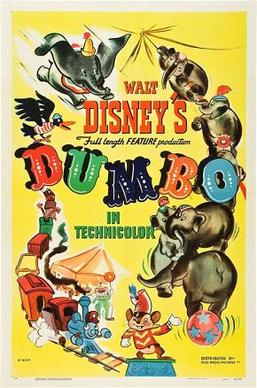
Dumbo is what I consider a "signifigant" film in any number of ways.  Which seems rather silly to say- if all the Disney films weren't significant in some way, I don't suppose I'd be reviewing them, but on we press!  Here Disney sat, 1 for 3, in very real danger of bankruptcy and with really only 1 shot left to bail his studio out of ever-present financial dangers.  The last two films he produced set the standard of artistic innovation yet remained unrelatable to contemporary audiences.  So Walt put on the breaks and laid out two conditions for the next film:  keep it simple and keep it cheap.  Perhaps not the stipulations one would expect for a beloved masterpiece, but hey, this is Golden Age Disney and every pore still oozes with magic (plus I cheated and know it's gonna end well).  So for starters, all backgrounds went back to watercolors for the last time in over 50 years.  Oh how I wish there was never that movie that kept it from being forever, but we'll get there eventually, Elvis lovers.  Yeah it was cheaper, but also so vibrant, so fresh and colorful and storybookish I can't imagine any other medium possibly coming close. The design was also drastically simplified- gone was the rigid, gorgeous arty animation, in came looseness and softness.  Now any of these cutbacks could spell doom: I never advocate cheapness for cheapness sake.  Ohhh, just you wait until we hit the dreaded Xerox era if you don't believe me.  But what the artists took from these constraints and molded with their immeasurable talents cannot be praised highly enough.  They replaced icy high animation with warm, visceral storytelling and relatable characters.  The time they saved in details they invested in character animation: Dumbo is utterly expressive without any voice: we understand his plight completely through nothing but pantomime.  Gosh, I am getting carried away with myself.  So anyways, the film got made- and here's my favourite just completely Disney part of the whole tale.  Dumbo's other cost-cutting factor was the emaciated running time, I'm talking 64 minutes from start to end.  Well  RKO wasn't too pleased so they gave Walt an ultimatum: either cut it to a short, add more runtime or release it as a B movie.  Well Walt being exactly the genius that he was, said none of the above, this is feature film, A-list material and that is how it will be released.  Can you imagine that?  Of course you can!  Haven't you learned anything from your wholesome Disney upbringing?  Psh.

Ok ok, so can I get to the actual film now?  The pacing is tight, the scant runtime absolutely flies by, but is always enrapturing.  The story is just so sweet, and incidentally, this was the first film for Disney set in contemporary times, though I will admit not the one to take the most advantage of the setting.  Here, it still seems to be something of folk tales, having an almost mythic quality.  The characters are all well done, though oddly there were no voice acting credits.  But that's what IMDb is for.  Sterling Holloway makes his first Disney appearance here as the stork, as does Verna Felton.  Perhaps the most surprising of all is Cliff Edwards as, ahem, Jim Crow, completely unrecognizable from his role as Jiminy Cricket.  And yes, I suppose the crows should be addressed.  Racism was not as absent from Disney as the notorious self-sanitizing histories would have you believe (just check out the Fantasia review), and yeah the crows are a pretty blatant stereotype.  There isn't much way around it, however, I will stand in defense that though regrettable, it was not a mean-spirited, or even particularly negative portrayal.  It's quite true that the crows are, Timothy excepting, the only ones to accept Dumbo and find worth in him.  Who would you rather have as friends, the crows or the elephants?  Plus they have the best (well, maybe second best if you like crying) song in the movie.

And this movie has a heap of great songs.  Of course there is Baby Mine, the emotional centerpiece, the one where you are obliged to boo-hoo simply to prove you have a heart.  And it is a cruel, beautiful segment.  When I See an Elephant Fly is really, really good too.  I cannot believe the raucous song was sung by the same man who so sweetly crooned When You Wish Upon a Star.  The others are perfectly good too.... and then there's Pink Elephants on Parade.  Orchestrated as an elaborate drunk dream, but played out like the baby was tripping on acid (as if drunk baby elephants weren't bad enough), this is the stuff of nightmares.  Disney has had its share of absolutely terrifying sequences, and I'm pretty sure every movie I come to will get a new label of most psychologically damaging, but seriously, THIS is some wacked-out mess.  I don't know how, and I especially don't want to know why, but Norm Ferguson, supervisor for that sequence, rove the land somewhere between genius and utter lunacy.

All in All, Dumbo is a warm, cute cute cute, and yet utterly sincere movie.  Frankly, you can be as corny as you wish, utterly drive me insane with syrup if must, and I will eat it all up if you can convince me you are sincere (Therein lies my beef with child actors in general- a whole lot of cutesy without a drop of sincerity.  Give me a sincere pumpkin patch, Charlier Brown!).  Those who follow in its footsteps will utilize the strength of homey storytelling and gestural characterization in varying degrees of sincerity, for it is a formula that works- when done well.  Perhaps Dumbo has not the most agressive of storylines in the Disney vault and paved the way for bad habits in films that handled constrained budgets without the grace of this one, but I cannot judge it too harshly.  In a time when the struggling studio was ready to fly or fail, this little wonder glided straight to the bank.

If only I could leave it there, a happy tale of a company that regained its footing and continued to make wonderfully brilliant movies in a magic kingdom until eternity.  Unfortunately, within Dumbo's production was one last pivotal moment, one that would bring the family to an end.  In May of 1941, the majority of the studio's animators went on strike.  Justified they might have been in their claims, but it cut Walt to the quick, and he is, after all, the hero in this tale.  Not to say he was perfect, but if I must choose protagonists, there is none more worthy of my overwhelmingly undue affections.  And eventually the issue was resolved and the animators came back, but it was never the same.  The family atmosphere had been destroyed: it was no longer Uncle Walt and his boys, it was Mr. Disney, the boss, and his staff.  Gosh, this is sad stuff, but there is hope!  Bambi, the last of the Golden Age films, was actually already in production before Dumbo was shuttled in and out, and though the strike certainly affected it, the ultimate results would not be felt for one last film.

Quote of the Film:
-Did you ever see an elephant fly? 

-Well, I've seen a horse fly. 
-Ah, I've seen a dragon fly. 
-Hee-hee. I've seen a house fly.

My Rating:
8/10********

Thursday, February 24, 2011

Star-Struck: Kiss Me Kate

It's Time to Brush Up Your Shakespeare


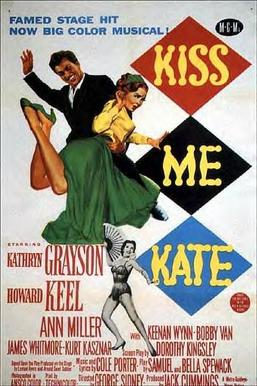
We kick off our Keel countdown with Kiss Me Kate, a film version of the Broadway show, itself a musical adaption of Shakespeare's Taming of the Shrew.  And let it be known far and wide, my love for all things Shakespeare- within reason.  I'm thinking my next list will be on Shakespearean adaptions.  And despite the moral bone a contemporary audience can pick with the play, it is undeniably clever in the sparring, often bitter spewings of a certain not-so-kissable Kate.  The tale is of two actors whose lives for the evening merge and somewhat mirror the main thrust of the play they are performing.  Fred (Keel) and Lilli (Kathryn Grayson) have ended their defunct marriage and will be giving one last performance together before she moves on to the greener pastures of a millionaire rancher.  As the show progresses, they reveal they are not as over one another as it may seem, though a series of mishaps involving costar Lois (Ann Miller) and her indebted gambling boyfriend (Tommy Rall) constantly get in the way.  All in all, it's a reasonably fun story, leaning a bit heavily on the "you must learn to obey your lord and master" side of things, but that is not to say that the Lilli/Kate character does not hold her own in a refreshing, for the 50's anywho, way.

Now, I must shamefully admit that I believed the 3D craze was a somewhat contemporary (sometime in the 90s-00s) thing.  I had absolutely no idea it went back in waves all the way to the 50s.  It puzzled me for the entire movie why actors were constantly throwing junk at the camera.  It was kind of surreal, like breaking the 4th wall in a way.  Now, I will never see this film in 3D, so I have no idea how successful it would have been, but it irks me to have that curtain of suspended reality somewhat raised.  But it is interesting, what with all the Avatar and 3D this and that, to know that they aren't such novel ideas after all.  Technicolor is hands-down the most beautiful way to shoot film in the history of cinema.  There is nothing more gorgeous, more lush than a film done well in technicolor.  Kiss Me Kate certainly takes advantage of the tool by having an outrageously saturated palette, in fact it often hurts during the stage sequences.  The overwhelming abundance of vivid colors, especially red, was on the garish side.  Kathryn Grayson looked beautiful as a blonde, perhaps even better than her natural brunette, but she was absolutely a fright in the hideous reddish wig they gave her Kate character.  I have never seen an actress with hair color less suited to her complexion or costumes.

Although I know it's a Broadway musical, I cannot help but be wearied by the sheer number of songs in the film.  The story could have been vastly lightened by the removal of some, where it would feel less like introduce a character- and sing about it!  Introduce a plot point- and sing about it!  Change scene- and sing about it!  I know I sound like the Emperor form Amadeus saying - cut a few, any few will do, but I am a big supporter of wanting songs to advance plot, not rehash and stall it.  Too Darn Hot, Why Can't You Behave, Brush Up Your Shakespeare and From This Moment On are the best of the 17 or 18 songs, though two I single out mostly for their dance routines.  From This Moment On is the best showcase of talent, a wonderful nod to the efforts of the dancers who don't always make it to the leading roles.

Speaking of, Ann Miller is saucy as ever and a wonderful dancer, one of the best tap dancers in Hollywood period as evidenced in Too Darn Hot.  Tommy Rall was just so talented- we'll be seeing him again shortly in Seven Brides for Seven Brothers.  Kathryn Grayson, she was alright.  I enjoyed the feistiness of her character, though I believe Jane Powell capitalized on the type better.  Though her voice is lovely, it can be so operatic and trilly I have difficulty following everything she sings, plus her style just doesn't mesh with the Broadway score or the styles of the other singers, except Keel, who could make a horse sound spectacular.  And then there's Howard Keel.  His character on script is a total douchebag: of all the characters on this list, this is the least likeable and the one with the shallowest arc.  But somehow when it's Howard Keel up there being all smarmy and whatnot, it's ok.  His charm and swagger are so powerful, all other senses are dulled while I quietly drool, knowing deep inside nothing he does could make it possible to despise him.  And I can't.  I simply cannot hate him.  Especially in guyliner.  Curses!

So over all, Kiss Me Kate is worth viewing, and viewing again.  Come on, it's Howard Keel doing Shakespeare while singing in a dead-sexy voice.  How can you not love it?

My Rating:

7/10*******